Finding Her Voice in Helping Others Find Theirs
- AAM MUMBAIKAR
- Aug 29
- 7 min read

In a city where conversations begin everywhere—from crowded local trains and busy cafés to school corridors and family dining tables—we rarely stop to think about how powerful the simple act of communication really is. For some, finding the right words comes naturally. For others, finding those words can become a journey.
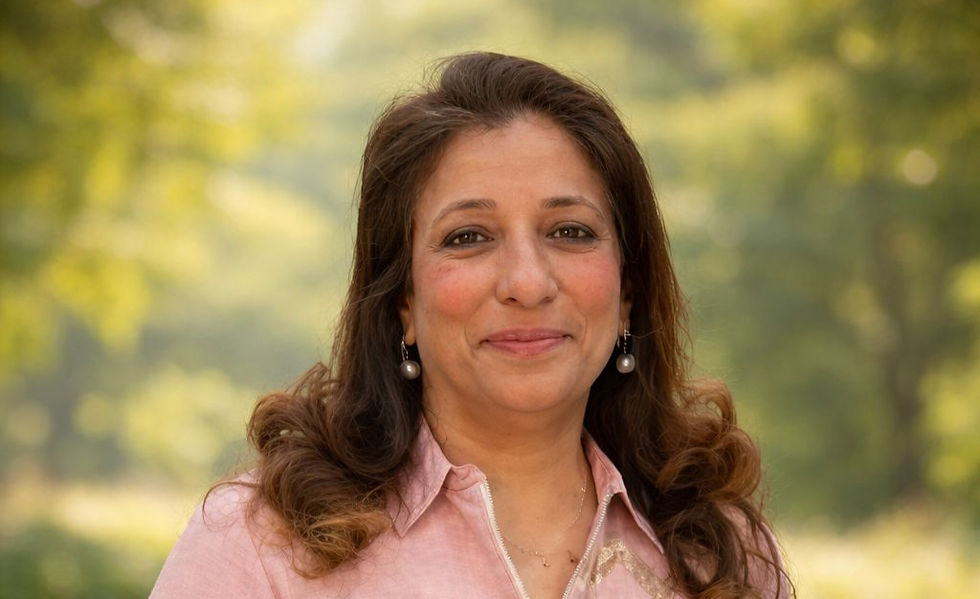
And for Dr. Nehal Kothari, helping people navigate that journey has become not just her profession, but her purpose.
As the founder and director of Let’s Talk Speech Therapy, a multidisciplinary rehabilitation centre in South Mumbai, Nehal has spent years helping children and adults communicate, connect and participate more confidently in the world around them.
But her own journey into this field wasn't something she had planned from childhood.
It began with something remarkably ordinary—a newspaper article. At a stage in her life when she was searching for a profession that could combine her interest in medicine and biology with meaningful human interaction, Nehal happened to read about speech therapy. Something about it stayed with her. Instead of simply moving on to the next page, she decided to find out what the profession was really about. She made enquiries, visited a setting where speech-language pathologists worked and observed them working with children.
What she witnessed gave her an entirely different perspective on communication.
She saw that sometimes, a single word can represent months of effort. That putting two words together can be a milestone. That a child's first word can bring an entire room to tears. And she realised that she wanted to be part of those moments. For Nehal, the magic of her profession lies in these small victories that may look ordinary to the outside world, but can mean everything to a child and their family. Hearing a child say their first word after working together for a long period can be an extraordinary moment. Seeing parents experience that milestone—with joy, relief and sometimes tears—gave Nehal a sense of gratification that few professions could offer.
Over time, she also discovered that the work was about much more than speech.
Communication is fundamental to who we are. It allows us to express our thoughts, needs, emotions and identity. It enables us to connect with the people around us and participate in everyday life. And when communication is affected, the impact can extend into almost every part of a person's world. That understanding became central to the way Nehal approached her profession.
Today, Let’s Talk Speech Therapy follows an interdisciplinary model. Instead of viewing rehabilitation from just one perspective, professionals from different disciplines collaborate to understand the individual as a whole.
The team includes Speech-Language Pathologists, Occupational Therapists, Counsellors, Special Educators, Remedial Educators, Clinical Psychologists, Neuropsychologists and professionals specialising in hearing impairment. It is an approach that recognises an important truth: different aspects of a person's development and functioning are often interconnected.
A communication difficulty may exist alongside challenges with learning, attention, sensory regulation or emotional well-being. An adult recovering from a stroke or acquired brain injury may need support not only with communication, but also with swallowing and other aspects of rehabilitation.
So the question isn't simply, “What is the problem?”
It is also, “Who is this person, and what do they need to live their life more independently?” That philosophy is reflected in the remarkably wide range of people Nehal works with. Her youngest patients may be around 18 months old, while some of the oldest can be in their 90s. Her work spans children with special needs, adults with acquired communication difficulties, individuals with autism and social communication challenges, professional voice users, and people dealing with swallowing and feeding difficulties. Speech-language pathology is at the heart of Nehal's work, but the field itself is far broader than simply helping someone pronounce words correctly. It can involve receptive language—the ability to understand what is being communicated—and expressive language—the ability to communicate thoughts, ideas, needs and emotions. It can involve speech clarity and articulation. It can involve voice rehabilitation for people experiencing hoarseness, breathiness, roughness or vocal strain, as well as specialised exercises for singers and actors who depend on their voices professionally.
It can even involve swallowing and feeding, from selective eating and feeding difficulties in children to dysphagia following conditions such as stroke or acquired brain injury in adults. Then there is the social side of communication—understanding social cues, taking turns in conversations, engaging appropriately with others and navigating different social situations. In other words, it isn't simply about teaching someone to speak. It is about helping them participate in life.

Nehal's professional foundation was built in Mumbai. She completed her Bachelor's degree in Speech and Hearing from Topiwala National Medical College and B.Y.L. Nair Charitable Hospital, where she trained in both Speech-Language Pathology and Audiology.
After completing her internship, she began working clinically as both a Speech-Language Pathologist and an Audiologist.
Those early experiences taught her something that would remain important throughout her career: there is no one-size-fits-all approach to rehabilitation. Two people may have similar difficulties but require completely different approaches. Clinical knowledge provides the foundation, but understanding the individual and adapting the intervention requires observation, experience and empathy. And Nehal continued to learn.
While working clinically, she pursued specialised training in PROMPT, a tactile-kinesthetic approach, at the Hospital for Special Surgery in New York. The training deepened her understanding of motor speech disorders, particularly apraxia, and taught her how tactile and kinesthetic cues could be used to facilitate speech production. But what stands out about her journey is that education didn't stop with a certificate.
Then her educational journey took her to The Ohio State University, where she pursued her Master’s degree in Speech-Language Pathology and received a university fellowship during her first year. In her second year, she as selected for the LEND (Leadership Education in Neurodevelopmental and Other Related Disabilities) program, an opportunity that exposed her to autism-focused, family-centred and interdisciplinary rehabilitation. Her clinical training at Ohio State included experience at Dodd Rehabilitation Hospital and specialized voice and swallowing clinics, where she worked with patients with neurological conditions, traumatic brain injuries, swallowing and voice disorders, tracheostomies, and professional voice users. she further broadened her expertise through specialized training in LSVT LOUD, VitalStim for dysphagia, fluency disorders, and research exploring breathing in children with cerebral palsy. She is also trained at Massachusetts Eye and Ear’s Voice Center in Boston, gaining deeper expertise in voice rehabilitation and professional voice care. She then moved to California, where she completed her Clinical Fellowship and earned her CCC-SLP from ASHA, while gaining extensive experience with children with autism in special-needs educational settings and older adults in skilled nursing facilities. She says - "Looking back, it was this combination of formal education, specialized training, hands-on clinical exposure and collaboration with professionals across disciplines that shaped my philosophy of interdisciplinary care and lifelong learning".
She brought that learning back into her clinical work in India, combining specialised training with practical experience.
For Nehal, learning has been an ongoing process—formal education, clinical exposure, mentorship, specialised training and continuous learning all playing a role in shaping the professional she is today.
Looking back, Nehal's work with adults also gave her a deeper understanding of what rehabilitation really means. She began to see that rehabilitation doesn't involve only the person sitting across from her.
Behind that individual is often a family that has been navigating uncertainty, fear, responsibility and hope.
Families can spend months or years supporting a loved one through difficult periods. Their journey becomes intertwined with that of the person undergoing rehabilitation. That helped Nehal understand that rehabilitation isn't simply about treating a disorder. It is about supporting the person—and the people around them.
Perhaps this is why empathy has become such an important part of her professional philosophy.
Looking back, Nehal describes her profession as the combination she had been searching for all along.
Medicine and biology.
Language and communication.
Science and psychology.
And above everything else, human connection.
What fascinates her is that the same scientific principles can be applied differently to every individual. One child may respond to an approach that doesn't work for another. An adult with an acquired communication difficulty may have an entirely different set of needs. The science provides the framework. The person determines the journey. And that is where clinical knowledge meets empathy.
Nehal's advice to the younger generation is simple: follow your dreams, find what you are passionate about, and keep learning, thriving and growing. Don’t feel pressured to follow stereotypical career paths simply because they are considered successful. When I entered this profession, even many in the medical fraternity had a limited understanding of the role and scope of speech-language pathology. What matters is recognising your talent, working hard, and having the courage to build your own path. At the same time, passion and financial stability both matter, and finding the right balance is essential. Pursue your talent with dedication, keep improving yourself, and let success and financial rewards follow your hard work.
Today, Nehal's work is ultimately about helping people find their voice, reconnect with others and participate more fully in their world.
In a city that celebrates speed, ambition and visible success, her story reminds us that some of the most meaningful achievements are measured differently.
Sometimes success is a child's first word.
Sometimes it is two words put together.
Sometimes it is an adult finding a way to communicate again.
Sometimes it is the look on a parent's face when something they have waited months—or even years—for finally happens. And sometimes, success is simply giving someone the confidence and independence to be heard.
Nehal Kothari started her journey because a newspaper article made her curious enough to look closer.
She stayed because she discovered something far more powerful.
A profession where science could create connection.
A career where empathy could change lives.
And a purpose built around something every Mumbaikar understands instinctively:
Everyone has a story to tell.
Sometimes, they just need a little help finding the words.


Comments